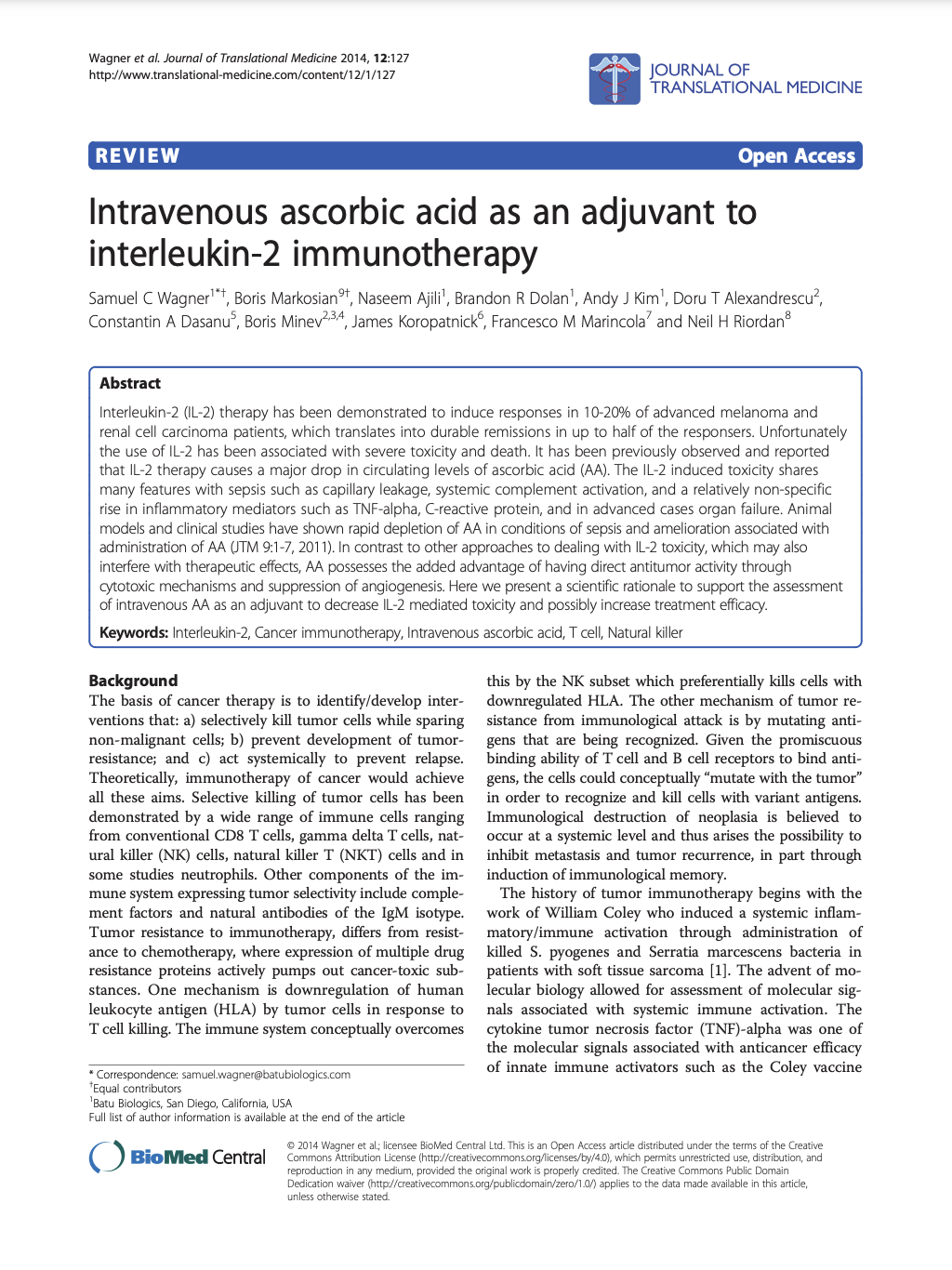


Intravenous ascorbic acid to prevent and treat cancer-associated sepsis?
Ichim TE, Minev B, Braciak T, Luna B, Hunninghake R, Mikirova NA, Jackson JA, Gonzalez MJ, Miranda Massari JR, Alexandrescu DT, Dasanu C, Bogin V, Ancans J, Stevens RB, Markosian B, Koropatnick J, Chen CS, Riordan NH.
J Transl Med. 2011 Mar 4;9(1):25
The history of ascorbic acid (AA) and cancer has been marked with controversy. Clinical studies evaluating AA in cancer outcome continue to the present day. However, the wealth of data suggesting that AA may be highly beneficial in addressing cancer-associated inflammation, particularly progression to systemic inflammatory response syndrome (SIRS) and multi organ failure (MOF), has been largely overlooked. Patients with advanced cancer are generally deficient in AA. Once these patients develop septic symptoms, a further decrease in ascorbic acid levels occurs. Given the known role of ascorbate in: a) maintaining endothelial and suppression of inflammatory markers; b) protection from sepsis in animal models; and c) direct antineoplastic effects, we propose the use of ascorbate as an adjuvant to existing modalities in the treatment and prevention of cancer-associated sepsis.
3/1/2011
J Transl Med. 2011 Mar 4;9(1):25
Ichim TE, Minev B, Braciak T, Luna B, Hunninghake R, Mikirova NA, Jackson JA, Gonzalez MJ, Miranda Massari JR, Alexandrescu DT, Dasanu C, Bogin V, Ancans J, Stevens RB, Markosian B, Koropatnick J, Chen CS, Riordan NH.
The history of ascorbic acid (AA) and cancer has been marked with controversy. Clinical studies evaluating AA in cancer outcome continue to the present day. However, the wealth of data suggesting that AA may be highly beneficial in addressing cancer-associated inflammation, particularly progression to systemic inflammatory response syndrome (SIRS) and multi organ failure (MOF), has been largely overlooked. Patients with advanced cancer are generally deficient in AA. Once these patients develop septic symptoms, a further decrease in ascorbic acid levels occurs. Given the known role of ascorbate in: a) maintaining endothelial and suppression of inflammatory markers; b) protection from sepsis in animal models; and c) direct antineoplastic effects, we propose the use of ascorbate as an adjuvant to existing modalities in the treatment and prevention of cancer-associated sepsis.
https://www.ncbi.nlm.nih.gov/pmc/articles/PMC3061919/
Ascorbic Acid; Systemic Inflammatory Response Syndrome; Neopterin; Multi Organ Failure; Ascorbic Acid Level
Ascorbic Acid|Ascorbic Acid Level|Multi Organ Failure|Neopterin|Systemic Inflammatory Response Syndrome